
A battery on the head: rethinking brain stimulation for epilepsy
For one in three people living with epilepsy, seizure control medication is not enough. Electric stimulation may help them better.
Published on October 13, 2026
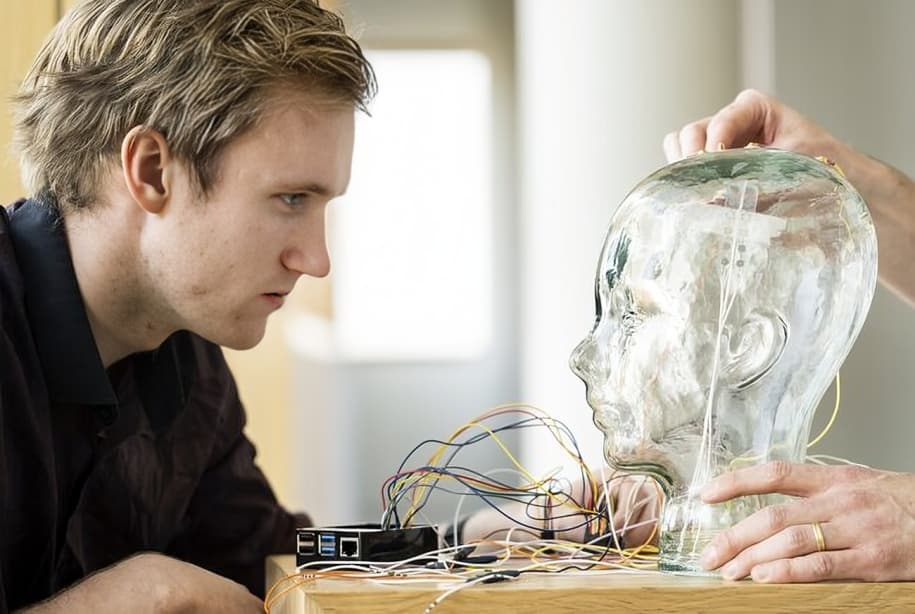
Steven Beumer - © Vincent van den Hoogen - TU/e
Mauro swapped Sardinia for Eindhoven and has been an IO+ editor for 3 years. As a GREEN+ expert, he covers the energy transition with data-driven stories.
To Steven Beumer, brain stimulation is straightforward to explain. “In essence, it is no more complicated than putting the two terminals of a battery on your head,” he says. “A current will flow, and you would feel it. Part of that current goes through the skull, which is very resistive, and there it interacts with the neurons around it.”
During his PhD at the Eindhoven University of Technology (TU/e), he studied the use of brain stimulation on epilepsy patients. The disease causes recurring seizures, which result in convulsions, shaking, or loss of consciousness. Seizure control medication doesn’t work in one in three people with the condition, and surgery is not always an option.
A seizure is an abnormal burst of electrical activity in the brain. Electrical stimulation aims to counteract these electrical spikes, Beumer studied localized seizures — the so-called focal seizures, originating from a specific area of the brain — and worked with transcranial direct current stimulation (tDCS), one of the main neuromodulation techniques.
How electrical stimulation works
In epilepsy, groups of neurons become overly excitable and fire together in abnormal bursts. The goal of neurostimulation is to make them less excitable to reduce the likelihood of seizures. With tDCS, a current passes through the skull and nudges neurons, ideally making them less likely to fire and reducing the likelihood of a seizure starting. But much of that current travels through the skin.
Placement is also crucial; usually, one electrode is positioned on the forehead, and another on the target area. Beumer built head models from magnetic resonance imaging (MRI) scans, using tighter electrode arrangements to focus on the brain region where the seizure begins.
What is epilepsy?
Epilepsy is a brain condition that causes recurring seizures. It comes in different forms; in some cases, doctors can trace the cause, which could be a brain injury, an infection, or a stroke. In others, the cause is unknown. Symptoms vary a lot; some people experience loss of consciousness, others experience jerky movements or convulsions. Seizures can affect the whole brain (generalized) or a specific brain area (focal).
The disease affects millions worldwide — 150,000 people in the Netherlands — and can be treated with anti-seizure medication. These work for approximately 70% of epilepsy patients. Those with drug-resistant epilepsy have to resort to either surgery or experimental neuromodulation techniques.
The surprise in the skin
Measuring the effect of tDCS is tricky, because researchers cannot look directly inside a healthy brain. In two studies, conducted with the university hospital of Ghent, of about 20 volunteers each, the team stimulated the motor cortex, then used a magnetic pulse to make a finger twitch. The amplitude of that twitch served as an indirect gauge of how excitable the brain had become.
In one study, they numbed participants' scalps. "When we anesthetize the skin, we take away part of the effect. So part of the effect of the stimulation is driven by accidentally stimulating the facial or cranial nerves," Beumer says.
Measurements in patients who already had brain electrodes for presurgical monitoring pointed the same way. In the one patient with complete data, the team saw no local effect at the stimulation site, but did see a whole-brain effect. The sample is tiny, Beumer stresses, yet it challenges the field's assumption that only current reaching the brain matters. Very focal stimulation, he suggests, might be overrated.
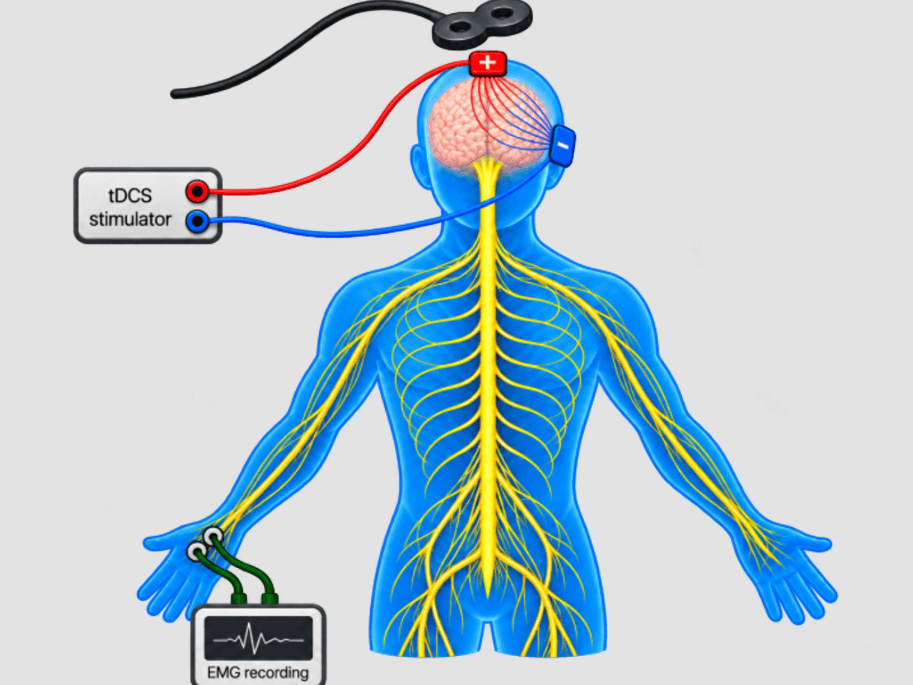
A scheme to illustrate brain activity measurement - © Steven Beumer
Toward treatment at home
More advanced methods, such as temporal interference stimulation, which can reach deeper brain regions with less skin sensation, are now being tested at the Kempenhaeghe epilepsy center — a close TU/e partner. Combining a patient's symptoms, EEG recordings and head models could allow stimulation to be tailored to each person.
"In my ideal view of the future, we could send them home with some kind of custom device, maybe a cap with electrodes in specific locations, so they can also be treated at home," he explains. Ideally, the device would work in a closed loop, detecting a seizure or EEG abnormality and responding instantly, since patients often cannot feel one coming.
Although optimistic, the researcher is cautious. “It's not yet a case of 'we use it, and the patient is cured.' And it will never be that for every patient,” he adds.
Beumer, an electrical engineer by training, will continue his research work studying invasive nerve stimulation, such as vagus nerve stimulation. He also brings EEG expertise from nearly two years in Geneva, where he explored whether early data could predict which patients will qualify for epilepsy surgery, sparing others a grueling four-week hospital evaluation.
Promising hills, not mountains
Looking back, Beumer's biggest lessons are about communication. In a field prone to pseudoscientific claims, he says, "sometimes it feels like we're promising mountains when we can only deliver hills."
At the same time, he says it's key for engineers and clinicians to work closely and keep talking so technology solves the problems doctors and patients actually have. One encounter stays with him: a patient tethered to a hospital bed for monitoring asked him, as an engineer, why it couldn't be done wirelessly. "There are usually a lot of small things that could easily make a patient's life better," Beumer says.
In ten years, he hopes to be both a scientist and a teacher. Sharing his knowledge and building more, especially with clinicians, drives him. "I don't really like doing research in my own little bubble."