
5 European alternatives to WhatsApp
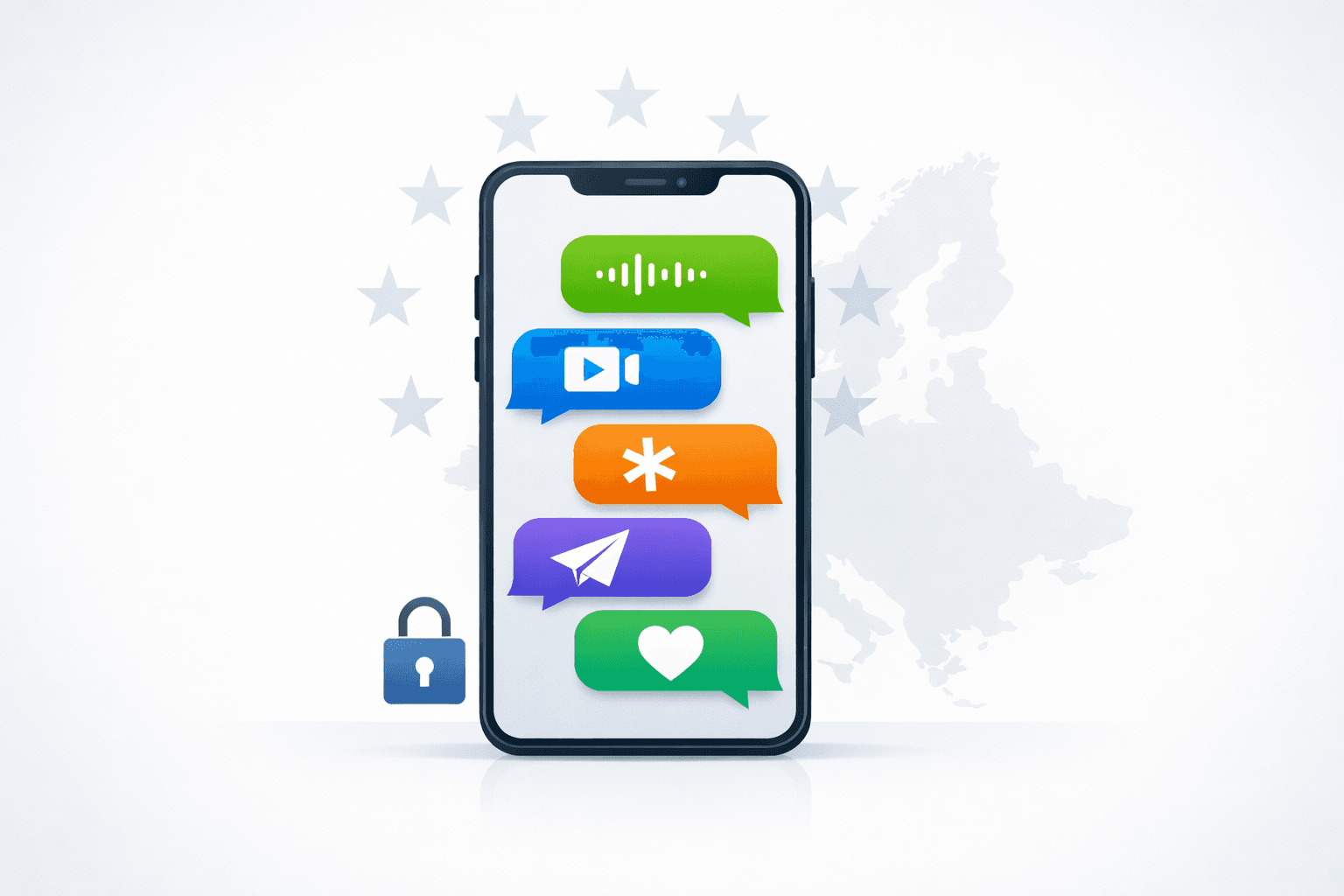
WhatsApp is the norm, but the Digital Markets Act is changing the rules of the game. Discover how EU regulations are breaking down Big Tech.
Published on January 22, 2026

Merien co-founded E52 in 2015 and envisioned AI in journalism, leading to Laio. He writes bold columns on hydrogen and mobility—often with a sharp edge.
The sound is universal. A short “ping” and your hand automatically reaches for your pocket. WhatsApp is not just any app; it has become the standard infrastructure for our social and business lives. We share baby photos, make business appointments, and send locations. The convenience is unparalleled. But the price we pay is invisible and high. We have completely outsourced our digital communication to Meta, an American company that thrives on data.
This puts European autonomy under pressure. Our conversations run through servers that are subject to US law. Although the content of your messages is encrypted, Meta knows exactly who you are talking to and when. This means that, in theory, the US government can always demand access. Fortunately, the playing field is shifting. New European legislation is forcing the tech giants to open their gates. This creates space for European players who do have privacy as a core value.
The European Alternative
The European Alternative is a series about European tech solutions that prioritize privacy, digital sovereignty, and sustainability. Instead of relying on major American platforms, we highlight the alternatives Europe itself has to offer—transparent, secure, and aligned with European values.
The stranglehold of Silicon Valley
The dominance of the big three—Meta, Google, and Apple—is stifling innovation in Europe. With WhatsApp and Messenger, Meta owns the infrastructure that billions of people use to communicate. Google and Apple, with their own messaging apps, iMessage and Google Messages, offer no escape from Big Tech; they, too, keep you trapped in the American ecosystem. Even if you opt for an “old-fashioned” text message, you are not safe.
On an Android phone, a text message is often converted to RCS (Rich Communication Services) without you noticing. This goes through Google's servers. On an iPhone, the same thing happens via Apple's iMessage. You think you're sending it through the telecom network, but your data still ends up in the cloud of a tech giant. This centralization is a risk to our digital sovereignty. If Meta decides to change the terms and conditions, European users have no choice. We either accept it or lose contact with our friends. This network effect has been WhatsApp's moat for years. No one switches to another app because no one else is there. It's the classic chicken-and-egg problem. European alternatives may have been technically superior, but without users, they stood no chance. Until now. With the Digital Markets Act (DMA), the European Union has thrown a crowbar into the fray.
The DMA: The end of the closed garden
The DMA is the most important tech legislation of this decade. The law designates major players such as WhatsApp as “gatekeepers.” The rule is simple: they must open up their platform to competitors. This is called interoperability. It means that you will soon be able to send messages to someone on WhatsApp using a different app. This solves the biggest problem with alternative apps. You no longer have to convince your friends to switch too. You choose privacy, they stay on WhatsApp, and you can still talk to each other. The technical implementation is complex but crucial.
WhatsApp requires linked apps to use the same strong encryption as itself, based on the Signal Protocol. This guarantees that the message content remains secure, even when it travels between different apps. Meta does warn about spam and privacy because it has no control over what the other app does with the data. Still, this is a huge step forward. It takes power away from the platform and gives it back to the user. You choose the app that aligns with your values, not the one everyone else happens to have. This opens the door for innovative European parties to finally distinguish themselves in terms of security and functionality, without first having to recruit a billion users.
5 European alternatives at a glance
- Threema (Switzerland)
Threema is the leader in privacy. It is a paid app, a conscious choice to prevent you from becoming the product. You pay once and get an app that does not require a phone number and does not store metadata. The servers are physically located in Switzerland, safely outside the US sphere of influence. - TeleGuard (Switzerland)
For those who don't want to pay, there is TeleGuard. You work with an ID instead of a phone number, and the app does not store user data on servers. They finance themselves with business functions, not data trading. It is a robust alternative that fully complies with the GDPR. - Skred (France)
Skred takes a radically different approach with peer-to-peer technology. There is no central server in between; the connection runs directly from your phone to the other person's. This means that nothing can be intercepted or stored by third parties. It requires no account details and offers absolute control over your data. - BirdyChat (Latvia)
BirdyChat is one of the first parties to implement interoperability with WhatsApp. The app focuses on the business market and allows professionals to chat with customers on WhatsApp from a secure environment. This keeps work and personal life separate without the customer having to switch. However, due to its professional focus, it is not a replacement for your personal WhatsApp use. - Haiket (United Kingdom)
Haiket has opted for a ‘voice-first’ approach to make conversations more natural. They also use the DMA to send messages to WhatsApp users. Although still in its infancy, Haiket proves that European security can be combined with the reach of American giants.
Why Signal and SMS are not the answer
Signal is often mentioned as the alternative. And technically speaking, that's true. Signal is the gold standard for security. Even the European Commission recommends it. But Signal is American. It falls under US jurisdiction. Although Signal stores hardly any data, it is not, in principle, a European solution that contributes to our strategic autonomy. Moreover, Signal has indicated that it does not want to participate in DMA's interoperability. They fear that linking with WhatsApp will dilute their strict privacy standards. So if you use Signal, you remain isolated.
Then there is the familiar SMS. It seems to be the most neutral option. It works on any phone and does not require an internet connection. But appearances can be deceiving. SMS is completely unsecured; messages are like postcards that anyone can read along the way. In addition, as mentioned earlier, SMS is increasingly being ‘intercepted’ by Google and Apple to add chat functions. You lose control without even realizing it. For a truly European alternative, we need to look at apps developed here, subject to our legislation, and that respect our privacy values. Fortunately, these do exist.