
3D-printed ankle implant promises near-natural movement
Ankle cartilage damage often means painful trade-offs. This tailor-made 3D-printed implant aims to change that.
Published on August 17, 2026
© Radboudumc

Team IO+ selects and features the most important news stories on innovation and technology, carefully curated by our editors.
A new treatment for ankle cartilage damage is under development through a collaboration between the University of Twente (UT) and Radboud University Medical Centre (Radboudumc). The project, named AMPLANK, aims to provide a less invasive alternative to traditional surgical options like ankle fusion and total ankle replacement, which often limit natural movement. This initiative is part of the HealthTech Nexus, a strategic partnership that accelerates healthcare innovation by integrating medical technology and clinical expertise.
Ankle cartilage damage disproportionately affects young and active individuals, often forcing them to choose between living with pain or undergoing aggressive treatments that restrict physical activity. Traditional options, such as ankle fusion (arthrodesis) and total ankle replacement, can relieve pain but at the cost of reduced mobility and long-term joint health. These procedures often require the removal of healthy bone, further compromising joint function.
"Ankle cartilage damage is especially common among people in physically demanding jobs. And the impact isn’t only on the individual patient," Athena Jalalian, assistant professor in the Advanced Manufacturing, Sustainable products & Energy systems research group at the University of Twente, says, "Pain can lead to time off work or reduced productivity, and if we look at the big picture, it could result in labor shortage."
A tailor-made ankle implant
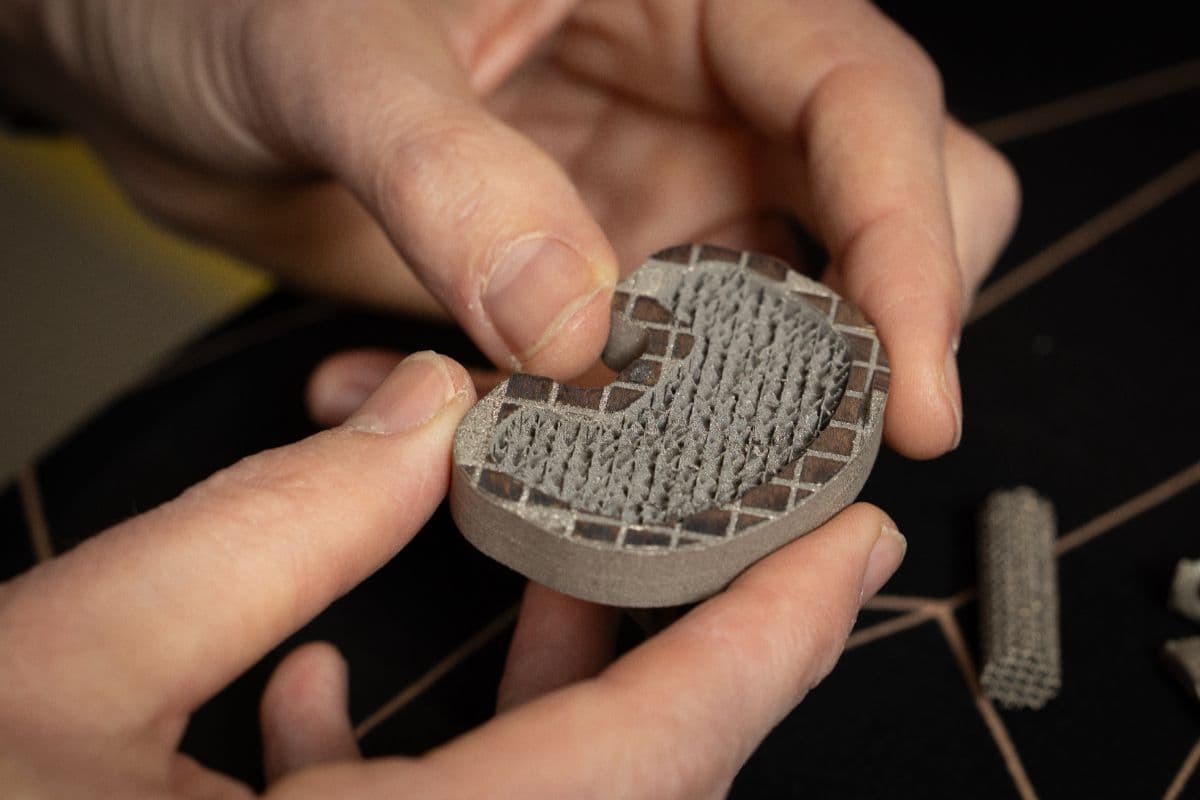
AMPLANK is a 3D-printed, patient-specific implant designed to address these limitations. Unlike one-size-fits-all solutions, AMPLANK is tailored to the unique anatomy of each patient’s ankle joint, preserving healthy bone and potentially restoring near-natural movement. The implant leverages advances in additive manufacturing, ankle imaging, biomechanics, and surgical techniques to create a precise fit. Early prototypes are being developed with titanium, a material known for its strength and biocompatibility in orthopedic applications. The design aims to minimize invasiveness while maximizing durability and integration with the patient’s anatomy.
"The implant is fitted to the patient instead of the patient fitting the implant," Jalalian says. Dennis Janssen, associate professor of simulations of bone and joint biomechanics at Radboudumc adds: "Using advanced 3D-printing techniques, we can create complex shapes and different sizes to match the damaged cartilage. We can also ensure stable fixation of the implant, reducing the risk of loosening, which is one of the causes of current implant failure."
Protyping phase ahead
AMPLANK is currently in the prototype development phase, with extensive testing planned to ensure safety and efficacy. Computer simulations will assess implant behavior under physiological loads, while anatomical evaluations will verify fit and performance. The research team is also collaborating with ankle surgeons to design a feasible surgical procedure, ensuring the implant can be deployed with minimal risk. If successful, the technology could extend to other joints with limited treatment options, such as the shoulder, elbow, and wrist. This phased approach reflects the rigorous standards required for custom implants, which must meet strict regulatory requirements for biocompatibility and mechanical integrity.
"Ideally, the implant could last as long as a total ankle replacement does," Janssen says. "But if it doesn't, it could be used as an intermediate option that gives the patient more time before a total ankle replacement is necessary. It may also reduce the number of revision surgeries."