
2026: More investment in European cloud infrastructure
Experts predict: the European Union will strengthen its digital sovereignty in the cloud sector by 2026.
Published on December 29, 2025
.png&w=2048&q=75)

Our DATA+ expert and Editor-in-Chief, Elcke Vels, explores AI, cyber security, and Dutch innovation. Her "What if..." column imagines bold scenarios beyond the norm.
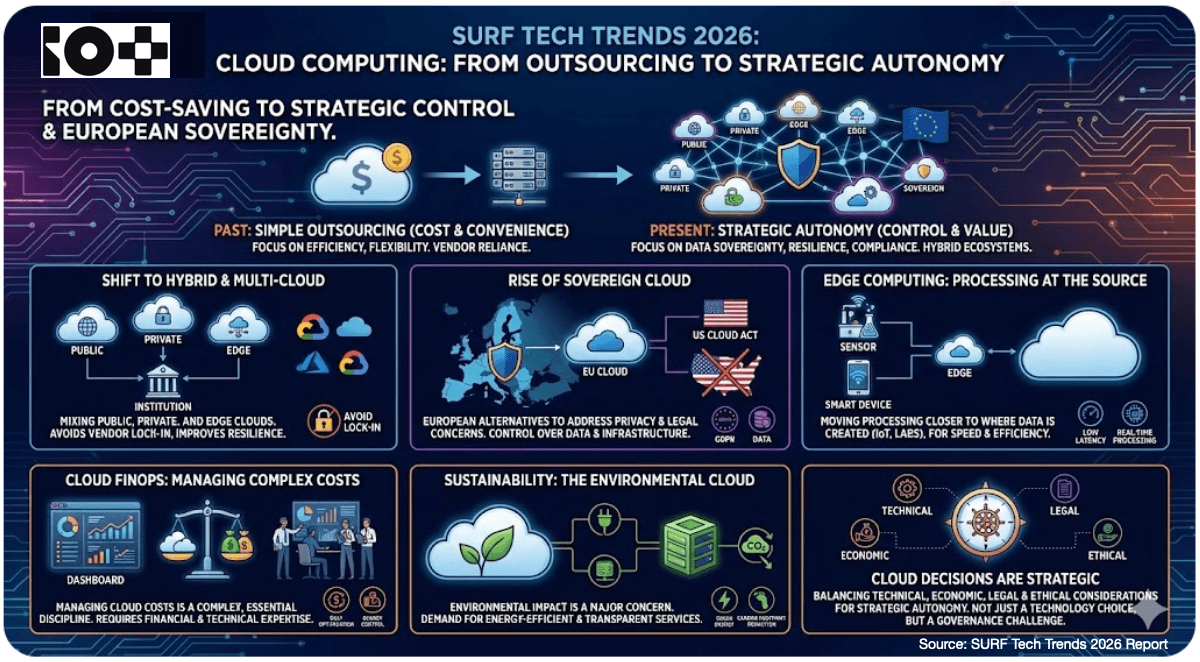
The European Union will strengthen its digital sovereignty in the cloud sector in 2026. That is the prediction of experts in the Tech Trends Report 2026. With large-scale investments and initiatives such as the Cloud and AI Development Act, Europe aims to at least triple the capacity of European data centers over the next 5-7 years.
Tech Trends 2026
The Tech Trends Report 2026 is a biannual publication based on international trend studies and market reports, enriched with insights from experts from and around the SURF cooperative. In ten episodes, IO+ and SURF look ahead to the most important technological developments of the coming year.
Cloud computing and edge computing market growing
The report focuses specifically on cloud computing, where data and programs run on large computer servers located elsewhere, and on edge computing, where data is processed as close as possible to the user or the device itself. The integration of cloud computing and edge computing enables organizations to improve their IT infrastructure with low-latency processing.
The global edge computing market was estimated at $23.65 billion in 2024 and is expected to reach $327.79 billion in 2033. The European Commission estimates that by 2030, 75% of European companies will be using cloud-edge technologies for their operations.
GPUs and AI chips
The rise of generative AI is having a major impact on the cloud market. To handle heavy cloud tasks, cloud providers and large users such as research institutions are investing in special hardware, such as GPUs and AI chips.
One example is the LUMI supercomputer in Finland. LUMI is one of Europe's most powerful supercomputers and is used for research into AI, climate, and health, among other things. The computer can process enormous amounts of data simultaneously and is specially designed for heavy computing and AI tasks.
Competition from American hyperscalers
Despite Europe's ambitions and investments, the market share of European cloud providers has remained relatively stable at around 15% of the European cloud market. This highlights the continued dominance of American hyperscalers. American tech giants such as Amazon, Microsoft, and Google still account for a large share of the European cloud market.
Europe's response: taking control
Europe is taking steps to gain more control over its own cloud sector. In 2025, the European Commission proposed the Cloud and AI Development Act. With this law, the EU aims to at least triple data center capacity over the next 5 to 7 years.
Initiatives such as the European Open Science Cloud (EOSC) and Gaia-X also offer environments that are aligned with European values, in response to the growing demand for digital sovereignty. These developments are crucial, as more and more European customers are considering leaving American hyperscalers.
The European Open Science Cloud (EOSC) was set up to provide European researchers with a shared digital environment. In this environment, they can securely share data, software, and computing power, in accordance with European agreements on privacy and accessibility.
In the Netherlands, work is underway on a national Gaia-X test bed: a trial environment in which companies and institutions can experiment with this new way of collaborating in the cloud. This is important because more and more European organizations are questioning whether they want to remain dependent on large American cloud companies.