
12+1 Dutch energy startups shaping the energy transition
Twelve startups that illustrate how the Netherlands is becoming a lab for the technologies that will power a low-carbon energy system.
Published on June 12, 2026
Bart, co-founder of Media52 and Professor of Journalism oversees IO+, events, and Laio. A journalist at heart, he keeps writing as many stories as possible.
Across the Netherlands, a new generation of startups is rethinking how energy is produced, stored, and managed. While the public debate about the energy transition often focuses on large infrastructure projects like wind farms, hydrogen networks, and grid expansion, a quieter revolution is taking place in laboratories, industrial campuses, and startup hubs. From tidal power in Friesland to hydrogen-bromine flow batteries in Gelderland, and breakthroughs emerging as far south as Limburg, entrepreneurs across the Netherlands are tackling the transition’s most stubborn challenges: intermittency, storage, material scarcity, and grid congestion.
Taken together, these innovations reveal a remarkably diverse ecosystem. Some companies focus on new forms of energy generation, such as tidal or floating solar power. Others take on the equally crucial challenge of storing renewable electricity, with technologies ranging from saltwater batteries to subsea storage systems. Still others are building the digital layer of the future energy system, orchestrating thousands of distributed energy assets into flexible networks.
This article highlights twelve startups - yes, one from each Dutch province - that illustrate how the Netherlands is becoming a laboratory for the technologies that will power a low-carbon energy system. And there’s a plus one. Going from north to south:
Groningen: SkyNRG
Solution: sustainable aviation fuel for a sector that cannot afford to wait
Sustainable aviation is caught in a difficult transition phase. Everyone knows flying has to become cleaner, but for long-haul flights, fully electric or hydrogen-powered aviation is not yet a realistic large-scale solution. Sustainable Aviation Fuel, or SAF, is therefore one of the most concrete ways to reduce CO₂ emissions from existing aircraft. Although the market still needs to mature, SkyNRG in Delfzijl is already taking a major step. With DSL-01, the company is building a plant that will convert waste fats and oils into sustainable aviation fuel. The company claims this will be the first Dutch facility fully dedicated to SAF and by-products. Once operational, the plant should produce 100,000 tonnes of SAF and 35,000 tonnes of sustainable by-products annually. Construction started in 2026; the first fuel volumes are expected in 2028. That makes SkyNRG Delfzijl more than just a factory. It is an attempt to build a missing link in the aviation ecosystem before the market is fully ready.
Friesland: SeaQurrent
Solution: tidal energy generation
SeaQurrent focuses on generating electricity from predictable tidal currents, offering a renewable energy source that complements intermittent wind and solar. Its flagship technology, the TidalKite, resembles an underwater kite that moves through tidal currents in figure-eight patterns. This motion multiplies the effective water speed around the turbine, dramatically increasing power generation efficiency. Because tides are highly predictable, tidal energy can provide a stable baseline in the renewable energy mix. The company’s first commercial projects in the Wadden Sea aim to demonstrate how tidal power can supply coastal regions with reliable, clean electricity while having minimal visual impact.
Drenthe: Resato
Solution: hydrogen refuelling technology for a market still waiting for its breakthrough
Green hydrogen has for years been the promise that has yet to make its definitive breakthrough. The technology exists, the climate need is obvious, and the plans are ambitious. Yet reality remains stubborn: vehicles are scarce, customers hesitate, infrastructure is expensive, and without refuelling stations there will be no users. That is exactly the chicken-and-egg situation in which Assen-based Resato Hydrogen Technology operates. The company has chosen not to wait until the market matures by itself. Resato is already building the backbone that will be needed once hydrogen mobility does scale up. Resato says it already developed 80 public and private hydrogen refuelling stations in Europe. This makes Resato an interesting example of a company that is not just building a product, but helping prepare an ecosystem.
Overijssel: CarbSorbTec
Solution: low-energy CO₂ capture from biogas
CarbSorbTec, a spin-off of the University of Twente, is developing a new method to convert biogas into a usable renewable fuel. The company uses a specially engineered clay material that can capture carbon dioxide directly from biogas streams, separating CO₂ from methane without the complex installations or high energy consumption typical of conventional gas purification systems. This process allows the remaining methane to be converted into biomethane, a renewable gas that can be injected into the natural-gas grid or used as a transport fuel. The technology could significantly improve the economics of biogas production, particularly for farms and small waste-processing facilities. By making CO₂ removal simpler and cheaper, CarbSorbTec helps turn organic waste into a reliable renewable energy source. At the same time, the captured CO₂ itself could become a feedstock for new industrial processes in the emerging circular carbon economy.
Flevoland: NRG2fly
Solution: charging infrastructure for electric aviation
NRG2FLY is building the missing link for zero-emission regional aviation: a charging network for electric aircraft. Instead of waiting for electric planes to arrive, the company is preparing airports now, with infrastructure assessments, grid connections, battery storage, renewable energy contracts, and operational support. Its flagship project at Lelystad Airport, part of Schiphol Group, combines public airside charging for aircraft and ground-support equipment, creating a blueprint for other regional airports. From the Netherlands, NRG2FLY wants to expand across Europe, where thousands of smaller airports could become energy hubs for short-distance electric flights. In a sector often seen as hard to decarbonize, the company makes electric flying practical.
Gelderland: Elestor
Solution: hydrogen-iron flow batteries
Elestor has developed a hydrogen-iron flow battery designed for large-scale electricity storage. Unlike conventional lithium-ion batteries, which become expensive for long-term storage, flow batteries store energy in liquid electrolytes, making them more scalable and economically viable. Elestor’s system uses hydrogen and iron as active materials, enabling storage durations of many hours or even days at relatively low cost. This makes it particularly suitable for balancing renewable energy on the grid. As wind and solar penetration increase, affordable long-duration storage technologies like this will be critical for maintaining grid stability.
Utrecht: iwell
Solution: smart battery systems for buildings
iwell focuses on energy storage combined with intelligent energy management software for commercial buildings and industrial sites. Its systems allow companies to store electricity when prices are low or when solar panels produce excess energy, and use it during peak demand periods. This approach reduces electricity costs while also alleviating pressure on congested power grids. In regions such as the Netherlands, where grid congestion is becoming a major barrier to electrification, decentralized solutions like iwell’s can play a key role in enabling further growth of renewable energy and electric infrastructure.
North Holland: Avantium
Solution: renewable chemistry for fossil-free materials
Avantium is not a classic energy startup, but its role in the transition is fundamental: replacing fossil carbon in everyday materials. From its headquarters in Amsterdam and plants in Geleen and Delfzijl, the company develops technologies that turn renewable feedstocks into circular plastics and chemicals. Its flagship innovation is FDCA, the key building block for Releaf® PEF, a plant-based and recyclable polymer for packaging, textiles, and films. By targeting the chemical industry’s dependence on petroleum, Avantium broadens the energy transition beyond power generation and storage. Its ambition is clear: use chemistry to help build a fossil-free, circular economy at an industrial scale.
South Holland: AQUABATTERY
Solution: salt-water energy storage
AQUABATTERY offers an elegant and sustainable approach to long-duration energy storage using water and table salt. The technology is based on a reversible process in which saltwater solutions of different concentrations store energy chemically. During charging, the flow of electricity creates a concentration difference; during discharge, the system produces power as the solutions mix again. Because the materials involved are abundant, safe, and recyclable, the system could offer a low-cost alternative for storing renewable energy at scale. Such technologies are particularly valuable for storing solar energy generated during the day for use at night.
Zeeland: Thorizon
Solution: molten salt reactors powered by nuclear waste
Thorizon wants to bring nuclear innovation back into the heart of the energy transition. The French-Dutch startup, backed by numerous investors, is working on what could become Europe’s first commercial molten salt reactor, planned in Zeeland for 2034. Unlike conventional reactors, Thorizon’s design uses liquid salt instead of solid fuel rods, creating a more stable system that can run partly on existing nuclear waste. That makes the technology both a source of low-carbon electricity and a way to make the nuclear cycle more circular. The reactor could also deliver high-temperature heat for industry, offering Zeeland a powerful new role in Europe’s clean-energy future.
North Brabant: LeydenJar Technologies
Solution: silicon-anode batteries
LeydenJar is developing silicon anodes for lithium-ion batteries, a technology that can significantly increase energy density compared to traditional graphite anodes. Silicon can theoretically store far more lithium ions, enabling lighter, more powerful batteries. This has major implications for electric vehicles, drones, and consumer electronics. Higher-energy-density batteries can extend driving ranges, reduce charging frequency, and lower the environmental footprint of battery production by requiring fewer cells for the same capacity.
Limburg: Solarge
Solution: lightweight circular solar panels
Solarge produces lightweight solar panels designed with circular economy principles. Traditional solar modules rely heavily on glass and aluminium, making them relatively heavy and difficult to recycle. Solarge’s polymer-based panels are lighter, contain fewer critical materials, and can be more easily recycled at the end of their life. Their low weight also enables installation on rooftops that cannot support conventional panels, unlocking additional solar potential in urban and industrial environments.
+1: RIFT
Solution: iron fuel for zero-carbon industrial heat
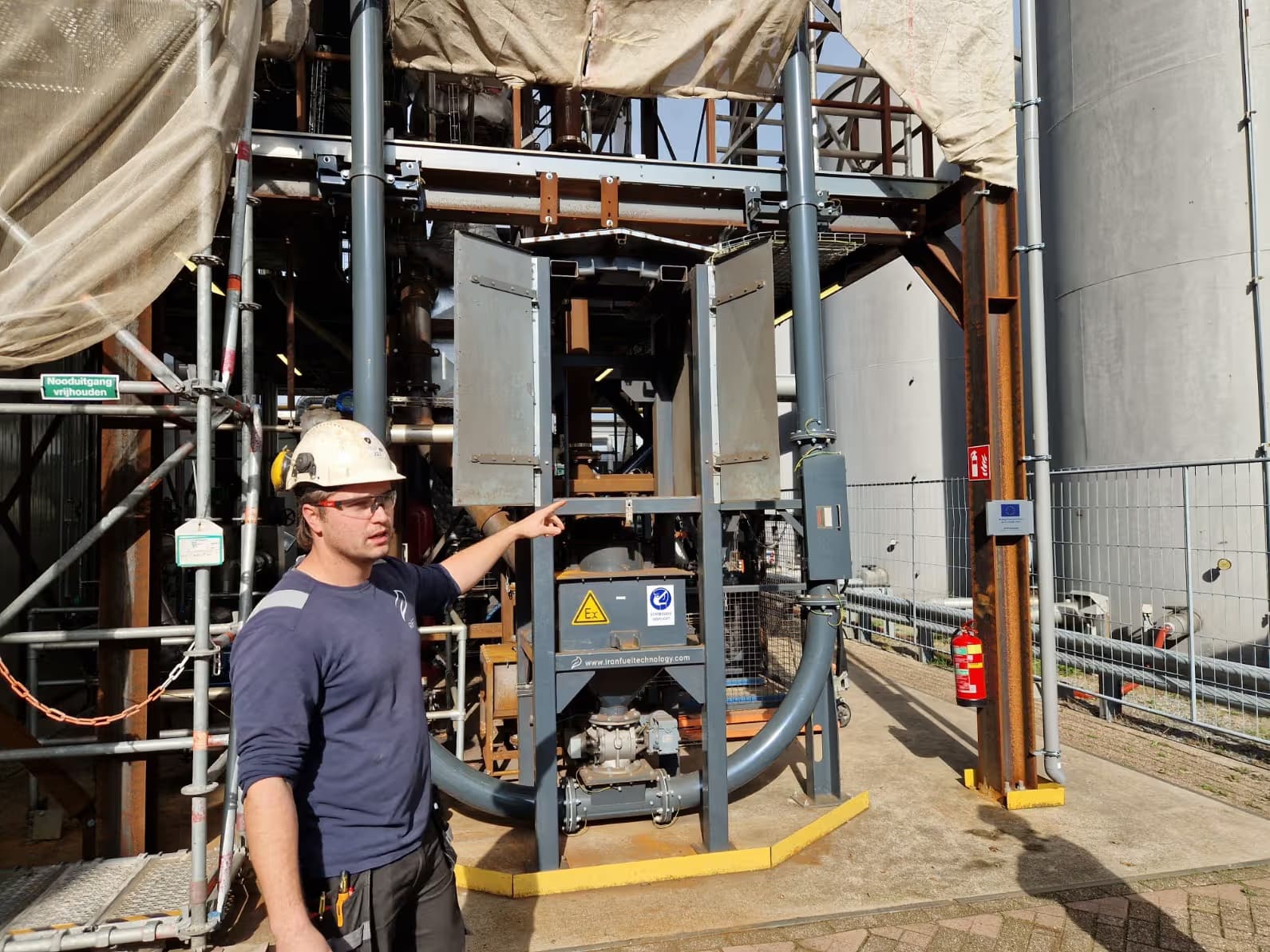
RIFT is developing a solution for one of the toughest challenges in the energy transition: providing carbon-free high-temperature heat for industry. Instead of relying on fossil fuels or inefficient electrification, the company uses iron powder as a fuel. Burning iron produces extremely high temperatures (up to 2,000°C) without emitting CO₂ and with only rust as a byproduct. That rust is then regenerated back into iron using hydrogen, creating a closed-loop system where iron acts as a reusable energy carrier. In effect, it functions like a rechargeable battery for industrial heat, enabling renewable energy to power sectors that are otherwise very difficult to decarbonize. Rift started at the TU Eindhoven, experimented in Budel and Lieshout, grew in Arnhem and is now planning a big factory in the Port of Rotterdam. It recently received € 15 million in funding to enable the ambitions.