One system
”From the powdered form of the material, the company 3D-prints a gauze-like structure. “A solid material ( composed of manganese, iron, phosphorus and silicon, ed.) transfers warmth and cold to an appliance,” Dusek goes on to explain. “To do this, we let water flow through the mesh-like material. This way, we can maximize the efficiency of the heat and cold transfer. Our technology is capable of reaching a very broad temperature range: from -80 C° up to +200 C°. This also means that it has a wide range of applications.” “The material in the heat pump cools or heats the water that flows through it. All you have to do is change the direction of the flow.” A separate boiler, air conditioning system, refrigerator or heat pump will eventually no longer be needed with the Magneto system, Dusek points out. “Our dream is to develop one system that takes care of the entire thermal management of a house or building.” In order to shed light on the problem that cooling poses, Dusek goes back in time.
Using your heating system to cool your home when it’s too hot outside
A heat pump can be used for cooling just fine by reversing the way it works, as an analysis by the Fraunhofer Institute for Building Physics IBP has shown.
Possibilities
“Until maybe a hundred and fifty years ago, people used ice to keep things cool. Ice that they collected in the winter and stored in their basements.” A hundred years ago, the refrigeration industry used propane and ammonia to cool things. “These turned out to be flammable (propane) and toxic (ammonia). Both gases have since been banned. However, the new kinds of gases caused holes in the ozone layer. Present-day gases, though, are safe for humans and do not cause any holes in the ozone layer. However, the greenhouse effect that they cause is much bigger, sometimes as much as ten thousand times more than a CO2 molecule.” The potential of the magnetocalorific material is formidable. Dusek: “It can be used to liquefy hydrogen. At extremely low temperatures, it can also be used in the pharmaceutical industry. And it’s also really well suited to industrial processes that are carried out at higher temperatures.” Given that the opportunities for this technology are so enormous, the start-up decided to involve companies – prospective clients – in the development process. “They possess knowledge of the target market, and they understand the needs that are out there. We are teaching them how they can develop a product with our technology.”Data centers and supermarkets
“For example, we are now in talks with a French manufacturer that has data centers as clients. We are working with them to see how they could translate our technology to their market: what temperature range is needed? What would the yield be? How much would it cost? Right now, we are doing a feasibility study with this French company.” Dusek also plans to conduct a pilot study at several supermarkets. ” It’s an interesting market for us. Supermarkets are under a lot of regulatory pressure. As a result, they are stepping over to systems that are far from ideal in terms of safety and efficiency.” For that reason, a consortium has been set up with a French company and a Dutch refrigeration systems company. “We want to bring the technology to supermarkets with the help of these companies.” According to Dusek, the difficult thing about working on an innovative piece of deep tech is “that there isn’t a market for it yet.” “We have got a fantastic material that has a ton of potential, but there isn’t any demand for it yet,” he adds. “It’s a bit of a chicken-and-egg situation. You have to develop the market at the same time that you are developing the product.” That is what Dusek’s area of focus is.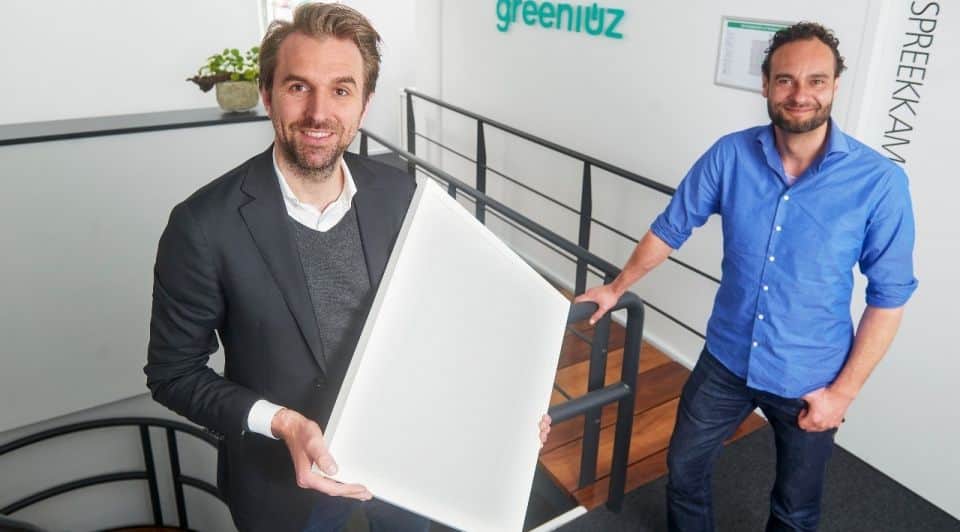
Greeniuz develops electric heat panels that completely heat your home without using gas
Start-up Greeniuz uses infrared panels that function as a primary heating system.
Europe
Dusek worked for Vodafone for the first ten years of his career. First based out of Prague, and later based in Dar es Salaam, Tanzania. The Czech held various commercial positions within the telecom company. “From sales, marketing, customer service to strategy. I have a good grasp of business. I know how to build a company. For one thing, Dusek started a renewable energy company in Africa. That company then also went on to establish itself in Southeast Asia. Dusek and his family lived in Myanmar for two years and in Vietnam for a year. “We weren’t quite sure if either of these places were really home to us. So, we decided to go to Europe.” His Canadian wife also found a job in the Netherlands. This is why Dusek looked for an opportunity to work there as well. “I really love the energy of start-ups. So, I was looking for a start-up with a good product or a good idea for a product. A start-up that I could then help launch onto the market.” He eventually ended up with Bowei Huang and Michael Maschek, the founders of Magneto who were working on technology at TU Delft.