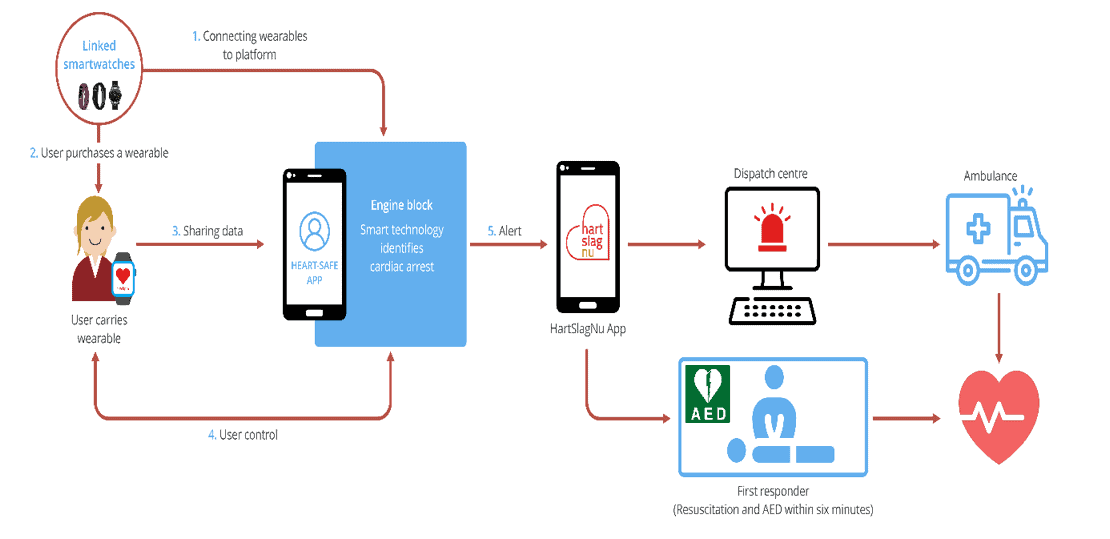
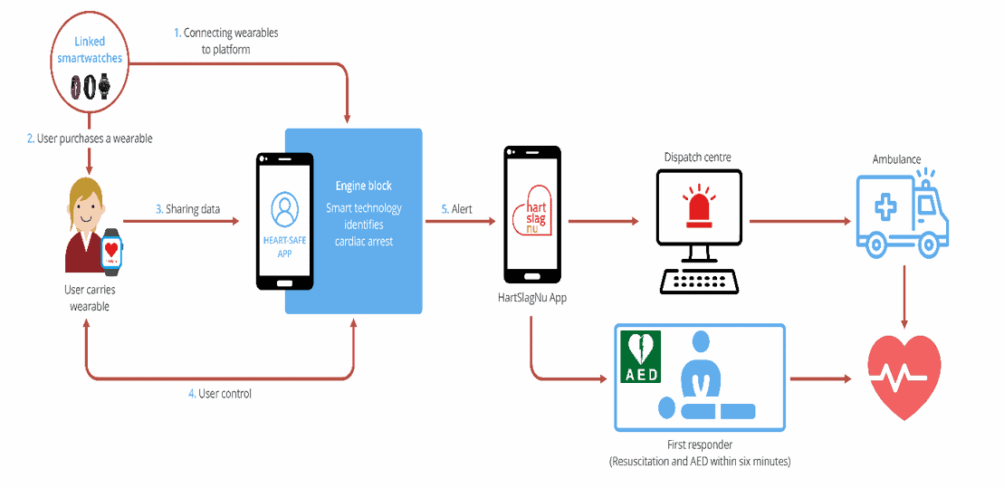
The University of Twente (UT) is developing a smart wearable to automatically and reliably detect out-of-hospital cardiac arrest (OHCA), and to trigger an immediate emergency response. To realise this project, the university has created an interface and algorithm, writes the university in a press release.
The UT will test the effectiveness of the proposed platform using simulation models and measure the impact on survival and response time. dr. Derya Demirtas of the UT explains their state-of-the-art solution: “Our solution will significantly decrease the time to cardiopulmonary resuscitation (CPR), potentially saving thousands of lives each year and improving neurologic outcomes.”
Developing
The university is developing an open-source cardiac arrest detection algorithm based on signals derived from monitoring the pulse rate and oxygen saturation. Demirtas: “By measuring changes in light absorption at characteristic wavelengths during pulsatile blood flow generated by the heartbeat, we enhance the diagnostic accuracy.” Additional sensors, like GPS, provide essential location data.”
The university also delivers a interface between the cardiac arrest detection technology and the citizen rescuer system HartslagNu as well as EMS dispatch centres. The system also provides a profile of the patient, providing essential medical data to rescuers and additional information needed to access the patient. The technical developments will be accompanied by extensive research to understand user needs, to train the AI-algorithm, to evaluate the technology, and to estimate the impact on survival and quality of life.”
The study is published in a medical journal.