A crisis like the corona pandemic calls for decisive measures. The EU has freed up €723.8 billion in an effort to use the Recovery and Resilience Facility (RRF) to pull the European economy out of the recession caused by corona. In order to qualify for a share of this large bag of money, member states must submit a plan to the European Commission. In the series Decarbonizing Europe, we put those plans under a magnifying glass.
“A clear signal for climate action and digitalization.” This is how last April, Olaf Scholz, then Minister of Finance and now the German Chancellor, described the Deutscher Afbau und Resilienzplan (DARP), as our eastern neighbors call the recovery plan. He does not overstate a single word: 42 percent of the total €25.6 billion in subsidies that Germany has secured will be spent on the “green” transition and 53 percent has been set aside for the digital transition.
Priority: green hydrogen
Climate policy and the energy transition are “priorities of the German government.” The DARP actually begins with these words. Alongside the renovation of 40,000 homes to become energy-efficient (€2.5 billion) and the promotion of a climate-friendly mobility sector (€5.5 billion), hydrogen is a key player in the German climate transition within the DARP. This comes as no surprise, especially in the wake of the ambitious hydrogen strategy that Germany presented in 2020. In it, the country expressed its aspiration to become a global leader in the use of hydrogen as an energy carrier.
According to Niklas Höhne, founder of the NewClimate Institute and endowed professor of Mitigation of Greenhouse Gases group at Wageningen University and Research (WUR), Germany sees hydrogen as a potential market in the future. Smart, but there are plenty of objections from a climate point of view. “The decarbonization process of the industry is jeopardized by such a strong emphasis on ‘green’ hydrogen. There won’t be enough green hydrogen available in the years ahead. Then the only alternatives are blue hydrogen or coal. That won’t do you any good, and in the worst case, it will only encourage the use of gas.”
Volker Quaschning, professor of Regenerative Energy Systems at the Technical University of Berlin, is also skeptical about the focus on green hydrogen. “With hydrogen, the government isomer or less making a promise that nothing has to change.”

Whatever the opinions are on hydrogen, the fact that it will be part of the energy transition is certain. The state of North Rhine-Westphalia alone expects to need between 70 and 160 terawatt-hours of hydrogen each year by 2050.
Quaschning: ” To be able to meet the demand, we will have to import hydrogen from countries where there is enough space to generate energy. A great deal of research will have to be done on this. Also on the transport of hydrogen, by the way.”
The DARP has earmarked €3.3 billion for these kinds of research and hydrogen projects. On top of that, €1.5 billion will go to joint research with France aimed at setting up a hydrogen value chain in Europe (IPCEI Hydrogen).
Germany and the digital transition: a complicated story
A second theme that gets a lot of attention (and just over half of the total budget) within the DARP is digitization. Contact between the German government and its citizens still hardly ever takes place via digital routes. Slow internet connections are the order of the day, and in 2018 two-thirds of transactions in Germany took place in the form of cash.

This subject is inextricably linked to decarbonization, says Höhne. “The transition to a sustainable ecosystem of smart chains can only be a success if everyone works together and is connected with each other. Without a central, digital system, we as one of the largest European countries are lagging behind.” The German government also seems to agree with this statement: 53 percent of the total budget is reserved for the digital transition. A remarkably high percentage (and well above the EU criterion of 20 percent): no other country is spending proportionally as much on digitalization.
Germany has to to do a lot to catch up and the €13.6 billion set aside for this area is not an unnecessary luxury, according to Höhne. “The administration system of our government is from the last century. During corona, we were forced to face the facts – the era of the fax is really over.”
Among other things, €3 billion will go to programs under the Online-Zugriffsgesetz – which is aimed at establishing a nationwide system of digital administration, another €3 billion to better digital infrastructure for hospitals, and a commitment to digitalization within the education sector (€1.4 billion).
“The administration system of our government is from the last century. During corona, we were forced to face the facts – the era of the fax is really over.”
Niklas Höhne
‘Mehr Fortschritt wagen’
According to Höhne, the biggest challenge for Germany in the climate transition has to do with speed. “the general public really do want it. The political parties also say they want it. But we have to completely overhaul the whole system. Fast. And as a society, in Germany we tend to be rather slow when it comes to change.”
With the coalition agreement ‘Mehr Fortschritt wagen’ (‘Dare to make more progress’), at least the SPD, FDP and the Greens seem to want to take on that challenge. “On paper it’s there, that’s a start at least,” Höhne smiles.
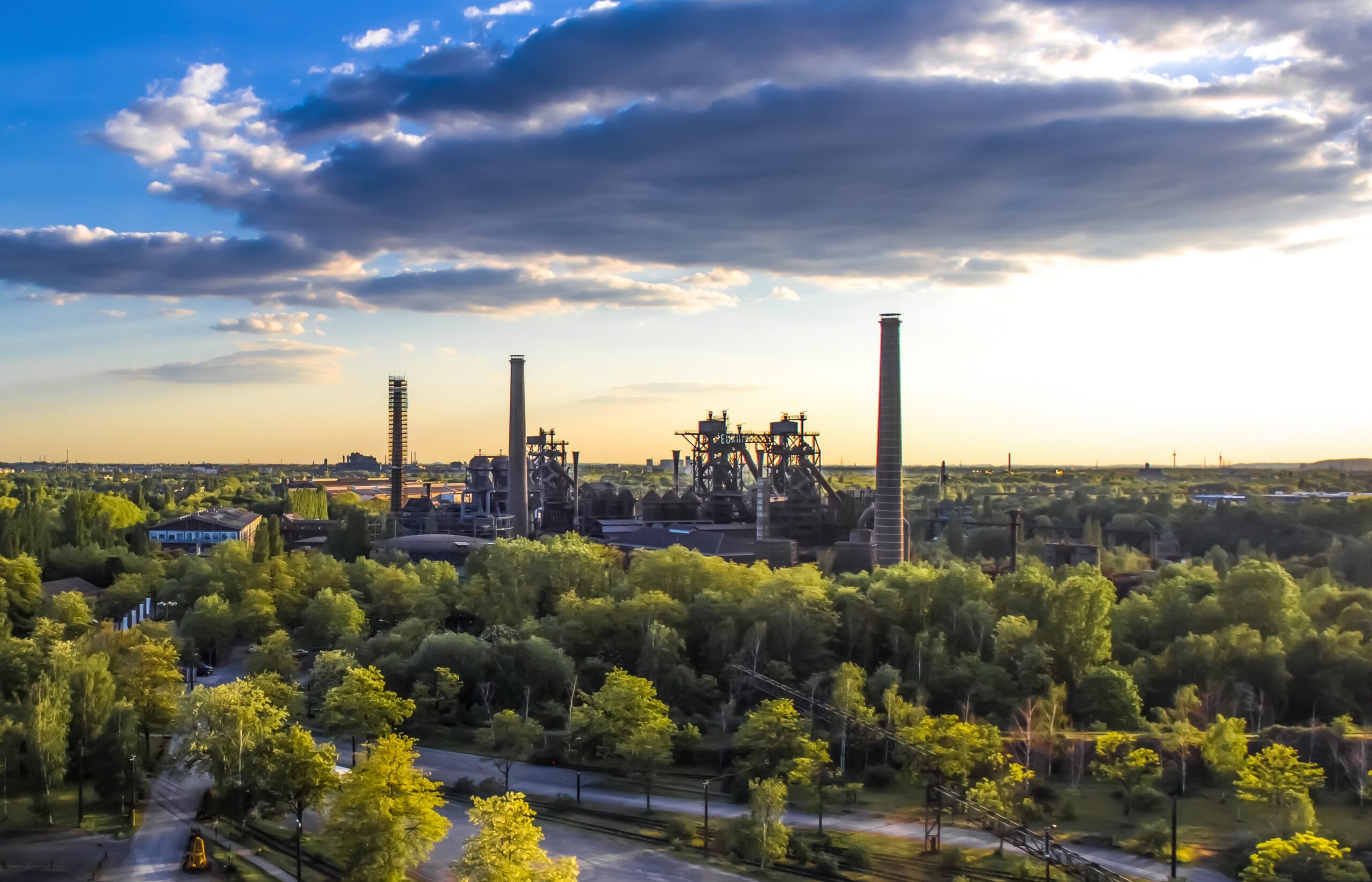
Photo: old steel plant near Duisburg (Ruhr district). (c) Pixabay
Read more about our project Decarbonizing Europe here
Read next: From brown coal to hydrogen land: Germany has a long way to go